What is Agile ERP? Implementation & Benefits
Sections: Implement ERP in iterative sprints. Deliver value faster, reduce risk, and keep users engaged from day one.
By Ximple Team
•
•
7–9 min read
•
ERP Implementation
What is Agile ERP?
Agile ERP deployment strategy is so trendy these days. Agile projects rely on small, achievable sprints or segments. Agile methodology creates high-quality outcomes because of the short development cycles, consistent improvements, and flexibility to edit work based on user comments and product assessments. As agile is adaptive, flexible, and evolutionary, most organizations prefer to use it when installing their enterprise resource planning software.
Key Characteristics of Agile ERP
User satisfaction: The ultimate goal of any agile team is to satisfy customers or users. Feedback is collected throughout the project to improve the end product.
Faster results: Agile projects deliver outcomes quickly, making it ideal for faster ERP implementation.
Customizable: Teams can re-evaluate goals and assumptions without starting over.
Collaborative: Success depends on cohesive teamwork among the agile team, clients, and end-users.
Transparency: Users are involved in all phases, allowing errors to be corrected early.
Early and frequent testing: Testing in each sprint ensures errors are fixed before launch.
Small milestones: Agile works in small, short-lived phases for easier tracking and delivery.
Minimal supervision: Teams are self-motivated, disciplined, and require little managerial oversight.
Good communication: Face-to-face interaction is prioritized for problem-solving and alignment.
Value-adding product: Agile teams focus on developing ERP solutions that solve real user problems.
Agile ERP Implementation Roadmap

Phase 1 — Discovery: Identify core processes, pain points, and MVP modules. Define user stories and acceptance criteria.
Phase 2 — Sprint 1: Deliver the smallest value-adding slice, demo it, and gather feedback.
Phase 3 — Expand: Iterate across Sales, Inventory, Purchasing, and Finance, maintaining a prioritized backlog.
Phase 4 — Scale & Govern: Ensure performance, security, change management, set KPIs, and implement continuous improvement loops.
Top Benefits of Agile ERP
Launch small segments at a time; stakeholders access ERP features early.
Users get immediate access to required information.
Reduces risk of failure through iterative delivery.
Fastest approach for deploying ERP systems with easy integration.
Transparent, flexible, and adaptable implementation process.
Best Practices
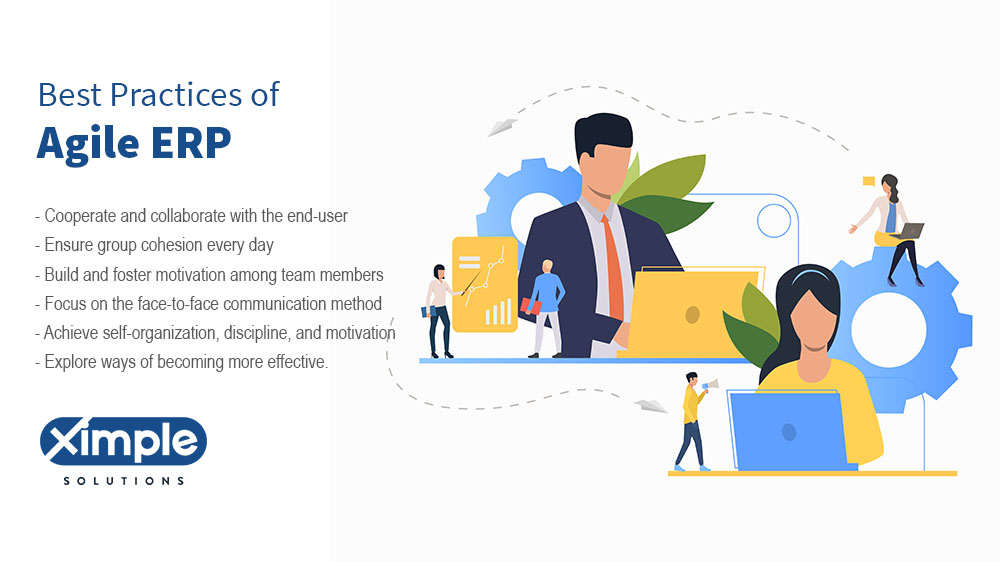
Cooperate and collaborate with end-users.
Ensure group cohesion daily.
Foster motivation among team members.
Focus on face-to-face communication.
Encourage self-organization, discipline, and motivation.
Explore ways to improve efficiency.
Pitfalls to Avoid
- Trying to deliver too much in early sprints.
- Weak stakeholder communication.
- Skipping retrospectives or UAT.
- Over-customizing before validating core flows.
- Under-investing in change management and training.
FAQ
It depends on the implementation success. Avoiding common failure points increases flexibility and adaptability.
Agile is a project management approach founded in 2001. In ERP, it is used to deploy software quickly with iterative sprints and continuous feedback.
Agile ERP allows organizations to release critical modules first, helping them respond faster to challenges, seize opportunities, and scale with business growth.
See Agile ERP in action
Walk through sprint‑based delivery, user demos, and rapid iteration.