
Modern, cloud-based purchase order and demand planning software built specifically for electrical, plumbing, HVAC, industrial, fasteners, tobacco, cash & carry, and general merchandise wholesale distributors. Replace spreadsheet-driven buying and generic ERP modules with the purchasing layer of a complete wholesale distribution ERP software platform — replenishment, demand forecasting, pricing, and supplier management unified across every branch, counter, and cash & carry location.
Ximple ERP gives purchasing, inventory, and operations teams one source of truth — so you can buy the right products, at the right time, from the right suppliers, reduce stockouts and overstock, and improve inventory turns across your wholesale distribution network of branches, counters, and cash & carry locations.
Purchase order software creates, tracks, and receives purchase orders — but most of it is built to control employee spending: requisitions, approval chains, and invoice matching. Ximple’s purchase order software is built for distributors who buy inventory to resell. It connects POs, live stock, sales history, and supplier data so buying decisions come from demand — and it runs inside the same distribution ERP as inventory, warehouse, and accounting, across branches, counters, and cash & carry locations.
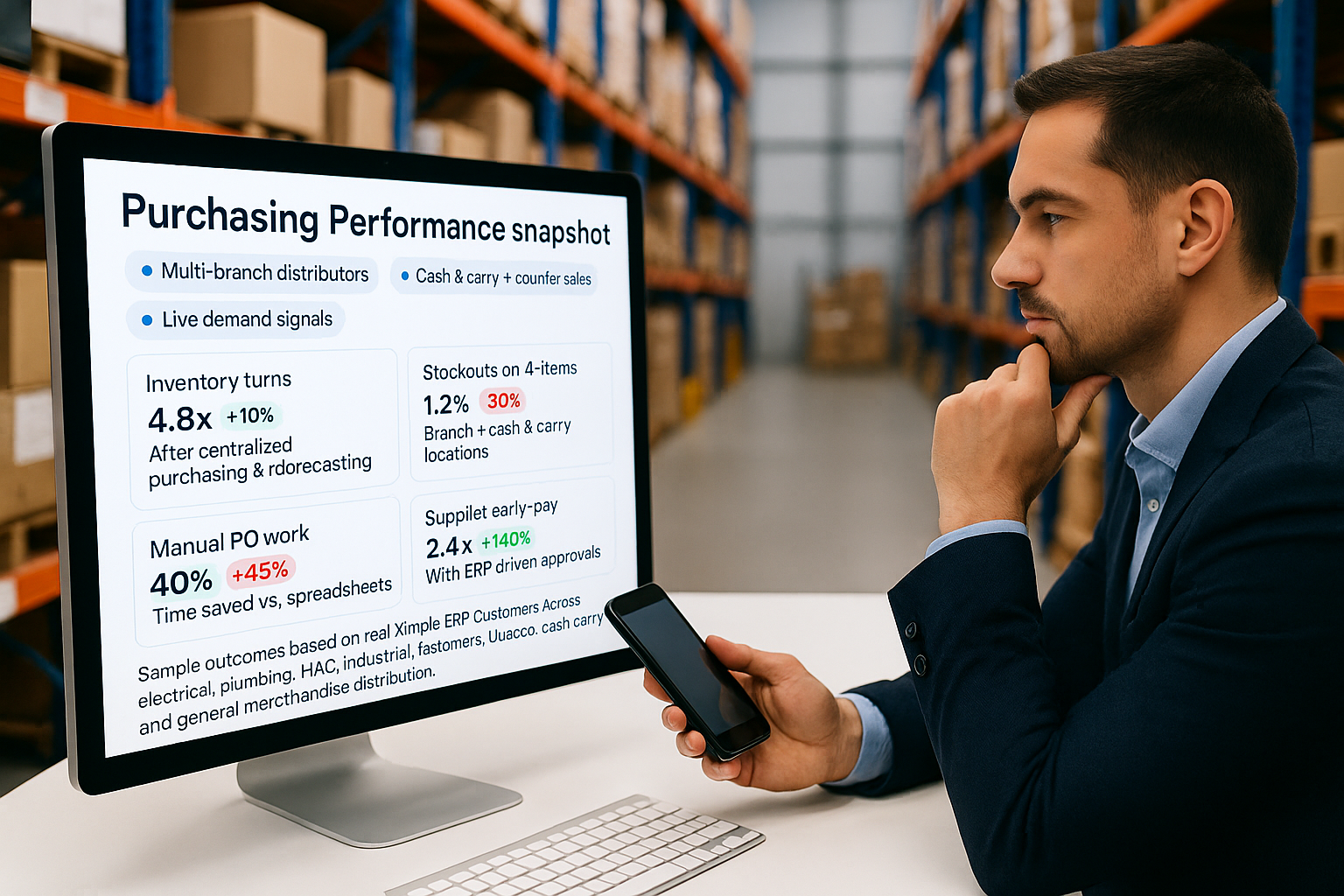
Ximple Purchasing ERP centralizes purchase requisitions, POs, demand planning, supplier performance, and multi-branch replenishment in a single cloud platform. It connects purchasing with sales, inventory, warehouse operations, and finance — so every buying decision is supported by real-time data and industry-specific logic.
Designed around the realities of electrical, plumbing, HVAC, fasteners, industrial, cash & carry, tobacco, and general merchandise distribution — including seasonality, FEFO, multi-UoM, and project-driven demand.
See all requisitions, POs, transfers, and inbound shipments in one place, with clear links to inventory levels, open sales orders, and supplier performance — across branches, counters, and cash & carry locations.
Support complex purchasing structures — centralized buying, branch autonomy, or hybrids — with configurable rules, approval workflows, and reporting that roll up across your distribution network.
Gain continuous updates, strong security, and modern APIs so your purchasing ERP can integrate with vendor portals, eCommerce, and analytics — without the friction of legacy on-premise systems.
Automated purchase order software usually means one thing: turning an approved requisition into a PO. Ximple goes further — it generates suggested purchase orders from your own sales history, seasonality, and supplier lead times, so the PO exists before the stockout does. Ximple ERP replaces spreadsheet-driven buying and disconnected tools with a single purchasing and demand planning engine, tuned for wholesale distribution. The result: fewer surprises, more predictable inventory, and stronger supplier relationships.
Capture purchase requisitions from branches, counters, eCommerce, and inside sales in a structured workflow. Route requests through configurable approval rules, convert to POs in one click, and track status from draft to receipt — without losing control in email threads or spreadsheets.
Use historical sales, seasonality, promotions, and vendor lead times to build demand plans and replenishment recommendations for every branch, counter, and cash & carry location. Move beyond gut-feel buying and react faster to demand shifts.
Track on-time delivery, fill rates, price changes, and rebate programs across all suppliers in one place. Use objective data to negotiate better terms, identify risk, and consolidate spend — while honoring local supplier relationships at branches, counters, and cash & carry outlets.
Ensure purchasing decisions align with your pricing strategy and margin goals. Ximple ERP connects landed cost, rebates, and contract pricing so buyers see the impact of purchase decisions on margins before placing the PO.
Tie inbound purchasing to warehouse capacities, slotting strategies, and putaway rules so stock arrives and flows efficiently. Ximple ERP aligns purchasing, warehouse, and logistics to reduce bottlenecks and receiving delays.
Provide role-based dashboards for buyers, branch managers, and leadership. Track fill rates, turns, dead stock, supplier performance, and cash tied up in inventory — in real time, not at month-end.
Standalone inventory replenishment software connects to your ERP to run these calculations — forecasts, reorder points, suggested purchase orders — and then syncs the results back. In Ximple, the replenishment engine is part of the distribution ERP itself: same database, the same item records your wholesale inventory management software tracks, nothing to integrate and nothing to keep in sync.
Not a slideshow of features. Bring your own items, suppliers, and branches, and we’ll run a real buy through Ximple — your history, your lead times, your numbers.
Every buyer has one buy they always get wrong — the seasonal item that gets overstocked every year, the A-item that stocks out anyway, the supplier lead time nobody trusts. Tell us yours and that’s where the demo starts.
The buying flow we’ll walk through
One connected path from demand to received stock: demand forecasting by branch, replenishment-driven purchase orders, supplier lead times and landed costs, and receiving that updates inventory instantly — on the same database as sales and accounting.
Start where your buying bleeds
Name the leak and sales prepares that exact demo — an overstock demo and a stockout demo are different meetings, and thirty minutes only fixes one thing at a time.
Bring One Buy You Always Get Wrong
The seasonal item you overbuy every year. The A-item that stocks out anyway. The supplier whose lead time nobody trusts. Bring that item — your sales history, your branches, your supplier — and we’ll run it through Ximple from demand to received stock. And if Ximple can’t fix it, you’ll know that too.
Purchasing, covered
Suggested POs • Supplier Management • Lead Times & Landed Costs • Multi-Branch Replenishment • Demand Forecasting • PO Receiving
Prefer to talk now?
No obligation. Talk directly with a distribution ERP specialist.
The software that replaces spreadsheets for wholesale distribution buying is a purchase order system connected to live inventory and sales history. Many wholesale distributors still rely on a patchwork of spreadsheets, email threads, and basic ERP purchasing screens. That might work when your business is small, but as you grow into multiple branches, counters, and cash & carry locations, the cracks become obvious — and expensive.
Without a clear picture of demand and lead times, buyers often overstock slow movers and starve critical A-items. The result: high carrying costs, write-offs, and lost sales even while the warehouse looks full.
Individual branches and counters may place their own orders based on gut feel, local relationships, or legacy habits. This fragments purchasing power, creates inconsistent pricing, and makes it hard to negotiate with suppliers.
When purchasing, sales, warehouse, and finance work in different systems, no one sees the full picture. It’s hard to identify trends, anticipate shortages, or understand the impact of promotions across branches and cash & carry outlets.
Ximple ERP is designed around the way wholesale distributors actually work — from central purchasing teams and branch managers, to counter sales and cash & carry operations. Here’s how the end-to-end flow looks in a typical implementation.
Step 1
Demand flows into Ximple ERP from counter sales, inside sales, eCommerce, project orders, and contracts. The system consolidates this into a single demand picture by item, branch, and customer segment.
Step 3
Buyers convert proposals into POs, grouped by supplier, item, or location. Approval workflows ensure that large or unusual buys are reviewed by the right stakeholders before release.
Step 2
The system uses your stocking strategies, service-level targets, and vendor lead times to generate replenishment suggestions for each branch, counter, and cash & carry location. Buyers review exceptions rather than building everything from scratch.
Step 4
As inventory arrives, warehouse teams receive against POs, reconcile discrepancies, and capture lot/serial information where needed. Purchasing, inventory, and finance teams all see the same truth.
Result: purchasing teams spend less time collecting data and more time making strategic decisions — while branches, counters, and cash & carry locations see better availability and fewer surprises.
Choosing the right purchasing ERP is not just about features — it’s about finding a platform that understands the complexity of electrical, plumbing, HVAC, industrial, fasteners, tobacco, cash & carry, and general merchandise distribution. Use this checklist as you evaluate options.
Look for support for the realities of wholesale distribution:
Your purchasing ERP should integrate cleanly with:
Ensure the platform offers:
Purchasing tools only deliver value if buyers, branch teams, and managers actually use them.
Ask how your ERP partner will handle:
Consider the full picture — not just license fees:
Below are common questions we hear from distributors evaluating Ximple ERP for purchasing and demand planning.
The best purchasing ERP for wholesale and cash & carry distribution combines procurement, demand planning, multi-branch replenishment, and supplier management in one system — and is built specifically for your industry. Ximple ERP is built specifically for electrical, plumbing, HVAC, industrial, fasteners, tobacco, cash & carry, and general merchandise wholesale distributors — so buying decisions are always grounded in the realities of your assortments, channels, and service-level targets.
Generic ERP purchasing modules are often designed for simple, single-location businesses or manufacturing environments. Ximple ERP is purpose-built for wholesale distributors with multiple branches, counters, and cash & carry locations. It includes industry-specific logic for electrical, plumbing, HVAC, industrial, fasteners, tobacco, cash & carry, and general merchandise assortments — plus deep integrations with inventory, WMS, pricing, and accounting.
Yes. Ximple ERP supports centralized purchasing teams, branch-level autonomy, and hybrid models. You can configure which items, suppliers, or categories are managed centrally versus locally, set approval rules, and still roll everything up into a consolidated purchasing and inventory view across your wholesale distribution network.
Implementation timelines vary by size and complexity, but many distributors begin seeing value from Ximple’s purchasing and demand planning capabilities within months. We start with a discovery of your current processes, then configure stocking strategies, replenishment rules, supplier data, and dashboards to reflect how your teams work today — and where you want to go.
Most purchase order software is built for spend control — requisitions, approvals, and invoice matching for companies buying supplies. Distributors buying inventory to resell need PO software that starts from demand: suggested orders from sales history, supplier lead times, landed costs, and receiving that updates stock instantly. That is what Ximple’s purchasing module does, inside a full distribution ERP.
Yes. Ximple builds suggested purchase orders from your own sales history, seasonality, current stock, and supplier lead times, by branch. Buyers review, adjust, and release — so automation does the math and people make the call.
Procurement software manages how a company spends — approval workflows, budgets, and invoice matching for internal purchases. Purchase order software for distributors manages what a company buys to resell — merchandise POs driven by demand, supplier performance, and margin. Ximple is built for the second job.
Whether you are an electrical, plumbing, HVAC, industrial, fasteners, tobacco, cash & carry, or general merchandise wholesale distributor, Ximple ERP can help you bring structure and discipline to your purchasing and demand planning processes.

Smart, fast, integrated —
that's Ximple ERP.
Cloud ERP software for wholesale distributors across the USA & Canada.
© 2026, Ximple Solutions. All rights reserved.