
Generic B2B platforms don’t work for electrical distribution. Ximple gives contractors a digital channel built around how they actually buy—with contract pricing, real-time ATP by branch, job-based ordering, and PunchOut/EDI—all connected to your ERP.
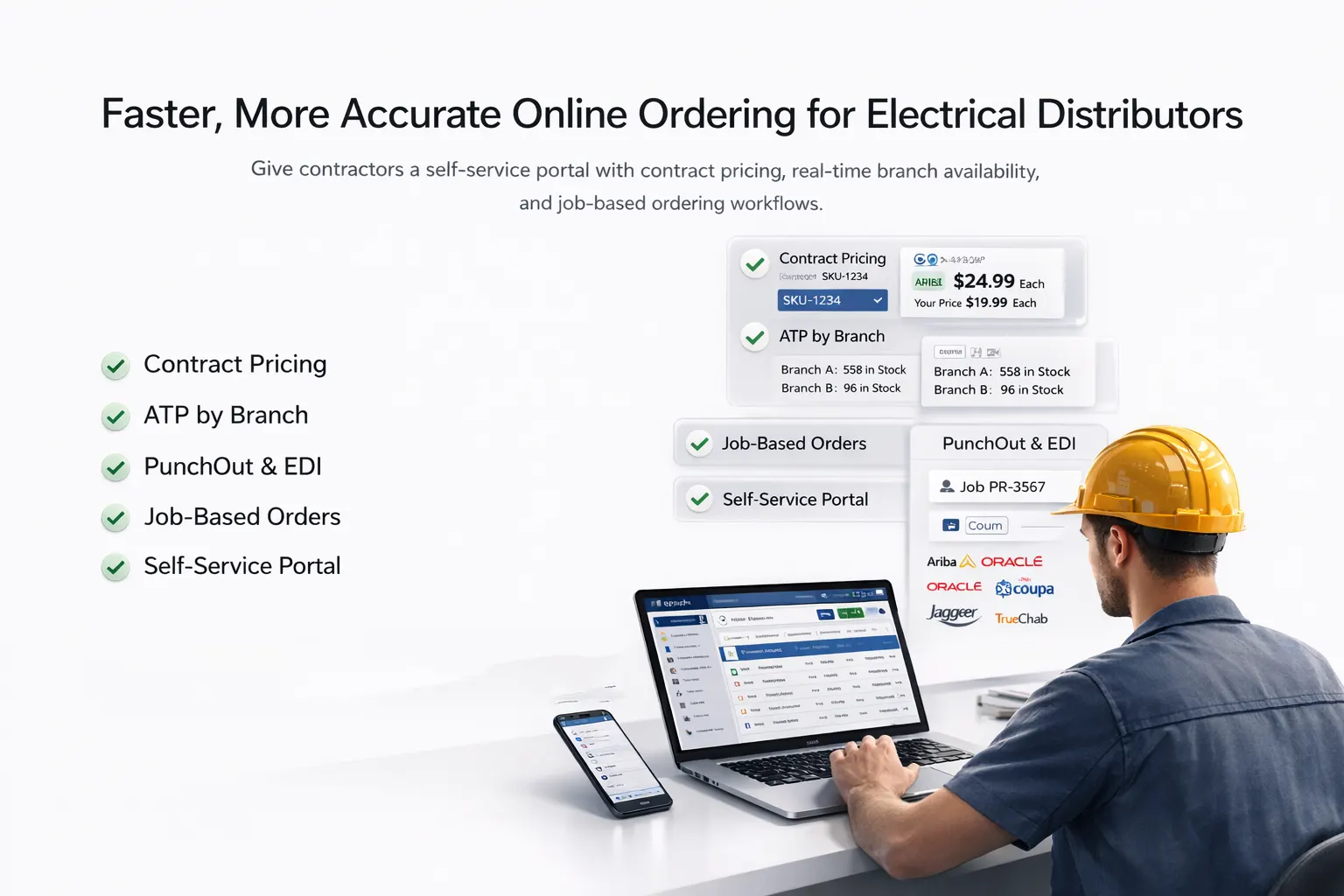
Electrical distribution isn’t retail. Your customers need contract pricing, branch-level availability, job tracking, and complex delivery options. Generic B2B platforms—even popular ones like Shopify Plus or BigCommerce—aren’t built for these requirements.
Generic platforms show list prices, not contract prices. Customers see one price online, another at the counter—and they stop trusting your web store.
Customers can’t see which branch has stock or choose pickup locations. They call the counter anyway—defeating the purpose of self-service.
Enterprise customers require PunchOut catalogs and EDI. Generic platforms need expensive add-ons that still don’t integrate properly.
Generic platforms can’t apply SPAs or track rebates at order time. Margin leaks and vendor claims get complicated.
Batch syncing means web inventory is hours behind reality. Customers order items that are already sold out or reserved for will-call.
Contractors need to assign orders to jobs, cost centers, or POs. Generic platforms don’t support project-based purchasing workflows.
Separate eCommerce database means daily reconciliation with ERP. Orders, inventory, and payments never quite match.
Consumer-style checkout frustrates contractors who need quick reorders, saved lists, and account-based purchasing.
Signs Your Current eCommerce Platform Isn’t Working:
Ximple’s digital commerce isn’t bolted on—it’s built into the ERP. Every channel shares the same pricing, inventory, and customer data in real time.
Self-service ordering with account pricing and history
cXML/OCI catalogs for procurement systems
Automated 850/855/856/810 transactions
Responsive ordering from jobsite or office
See what changes when you move from a standalone B2B platform to ERP-native digital commerce.
| Capability | Generic B2B Platform | Ximple eCommerce |
|---|---|---|
| Pricing | List price only; contracts require custom dev | Real-time matrix pricing, contracts, SPAs |
| Inventory | Batch sync; hours behind reality | Real-time ATP by branch, DC, in-transit |
| ERP Integration | Middleware, API sync, constant reconciliation | Native—no sync needed, same database |
| PunchOut | Expensive add-on, limited support | Built-in cXML and OCI support |
| EDI | Separate EDI platform required | Native 850/855/856/810 processing |
| Job/Project Orders | Not supported | Job numbers, cost centers, PO requirements |
| Customer Experience | B2C checkout frustrates contractors | Built for repeat orders, saved lists, quick reorder |
| Self-Service | Limited account features | Invoices, statements, payments, order history |
When digital commerce is connected to the ERP—not bolted on—distributors see measurable improvements in adoption, efficiency, and customer satisfaction.
40%
Increase in digital adoption
65%
Reduction in order entry calls
Zero
Daily reconciliation needed
100%
Pricing consistency
Surface the same pricing used at the counter. The catalog pulls from Pricing, SPAs & Rebates so every online price reflects current contracts and matrices.
Show branch-level available-to-promise so buyers choose pickup or delivery from the most appropriate location and avoid backorder surprises.
Use IDW & Trade Service content—specs, images, alternates, and cross-references—to help contractors find and confirm the right item.
Buyers see their branches, ship-to locations, negotiated pricing, and tax rules. Approvers can review carts and control spend by PO, job, or cost center.
Accept card and ACH, or allow on-account orders within credit limits managed in Finance AR.
Customers download invoices, see open balances, and pay online—reducing inbound calls and AR workload.
Moving from Eclipse doesn’t have to be disruptive. Ximple’s team handles the technical heavy lifting while your business continues operating normally.
• Customer and vendor master data
• Item master with IDW/Trade Service mapping
• Pricing rules, contracts, and SPAs
• Inventory levels by branch/location
• Open orders and purchase orders
• AR/AP open items
• Historical transactions (configurable)
• Alternates and pricing intelligence speed decisions.
• We review every customization during discovery
• Many Eclipse customizations aren’t needed—Ximple includes the functionality natively
• True custom requirements are evaluated for inclusion or alternative approaches
• You won’t lose functionality that matters to your business
No Middleware, No Sync Delays: Because Ximple eCommerce is part of the ERP, there’s no separate database to reconcile. Orders, inventory, and pricing are always accurate—no integration maintenance required.
Every step is designed for speed and confidence—with real-time data from your ERP.
Omnichannel: Every Order in One System
See their pricing, branches, and history
Search, browse, or quick-add by part number
See ATP by branch, choose pickup or delivery
Tag order with job, PO, or cost center
Pay or order on account within credit limit
Get updates on shipment and delivery
Enterprise customers and government buyers expect electronic commerce. Ximple provides native support—not bolted-on add-ons.
Support cXML, OCI, and other formats so large customers shop your catalog from their procurement system using your real-time pricing, ATP, and product data.
Works with: SAP Ariba, Coupa, Oracle, Jaggaer, and others
Exchange 850/855/856/810 and related documents through marketplace gateways. Orders, acknowledgments, ASNs, and invoices stay in sync automatically.
Supports: SPS Commerce, TrueCommerce, and direct connections
Use exception queues to manage mismatches without digging through raw EDI logs. Your team focuses on customers, not file troubleshooting.
eCommerce, PunchOut, EDI, counter, and project orders all share one ERP backbone. No reconciliation, no separate databases, no sync conflicts.
Web orders post directly to order entry—no middleware
Inventory updates in real-time across all channels
Same pricing engine for counter, web, and EDI
Picking and shipping handled in Inventory & WMS
Channel performance visible in Analytics
Customer sees consistent experience everywhere
Replacing a standalone B2B platform with ERP-native eCommerce eliminates integration headaches and ongoing sync maintenance.
Customer web accounts and logins
Saved lists and order templates
Order history (for display purposes)
PunchOut and EDI configurations
Product content and images
Week 1-4: Core portal configuration
Week 5-8: Customer data and testing
Week 9-10: PunchOut/EDI setup
Week 11-12: Soft launch and training
Go-Live: Full launch with promotion
Retiring Your Old Platform: Most distributors run both platforms briefly during transition, then retire the old one entirely. No more paying for separate eCommerce licenses or maintaining custom integrations.
Contractors use the portal more when pricing, ATP, and delivery status match what they hear at the counter.
Smarter vendor management and automated procurement.
Orders flow directly from customer systems into ERP, cutting rekeying errors and pricing disputes.
PunchOut and EDI meet corporate buyers where they work, without custom one-off projects.
Measure revenue, margin, and cost-to-serve by channel—digital vs. counter vs. project.
No middleware to manage, no sync jobs to monitor, no reconciliation at month-end.
Generic platforms don’t support electrical distribution requirements like matrix pricing, SPAs, branch-level ATP, job-based ordering, will-call, and complex UOMs. They also can’t sync with ERP in real-time, causing constant pricing and inventory discrepancies.
Yes. The contractor portal and PunchOut catalogs display real-time contract and matrix pricing, plus available-to-promise by branch so customers can choose the best pickup or delivery option.
Ximple supports cXML and OCI PunchOut formats, and EDI documents including 850, 855, 856, and 810 via marketplace gateways like SPS Commerce and TrueCommerce, plus direct connections.
Yes. Ximple replaces standalone B2B platforms that require constant syncing. Because eCommerce is built into the ERP, there’s no middleware, no sync delays, and no reconciliation issues.
Orders from the portal, PunchOut, and EDI post directly into order entry, update inventory and WMS immediately, and feed AR and analytics. There’s no separate web database to reconcile.
Yes. Customers view invoices, statements, and open balances, then pay via card or ACH. Payments post directly to AR, reducing manual processing and collections calls.
Most distributors launch within 8-12 weeks of starting implementation, often in phases—starting with core ordering and adding features like PunchOut, payments, and self-service over time.
Yes. The contractor portal is fully responsive and works on phones, tablets, and desktops. Contractors can place orders, check stock, and track deliveries from the jobsite.
Yes. Tax and freight calculations use the same rules and connectors as your ERP, so delivered cost is accurate and compliant across digital channels and counter sales.
Most distributors transition customers to the new portal over 30-60 days, then retire the old platform. Customer accounts, lists, and history are migrated so contractors don’t start from scratch.
See how Ximple compares for your specific situation. We’ll configure a demo around your product mix, pricing complexity, and operational requirements.
See B2B eCommerce built for electrical distribution.

Cloud ERP for wholesale distributors. Modern UX, reliable operations, and scalable performance.
© 2026, Ximple Solutions. All rights reserved.