
Intensive Distribution: 12 Examples and How to Run It
Sections: What Is Intensive Distribution?, How It Works, 12 Examples, Intensive vs Selective vs Exclusive, Advantages for Distributors, Challenges, What It Demands From a Distributor, Running It on XimpleERP, FAQ
By Ximple Team
•
•
3–4 min read
•
ERP Evaluation

What is intensive distribution?
Intensive distribution is a strategy that places a product in as many retail outlets and sales channels as possible, so a buyer can find it wherever they happen to look. It suits low-cost, high-turnover goods that people buy on impulse and will substitute in a second if the shelf is empty. This guide gives the twelve clearest examples, sets intensive against selective and exclusive distribution, and then covers the part almost nobody writes about: what it actually takes, operationally, to keep thousands of shelf positions filled.
Think about your daily life: a can of soda, a pack of gum, or a tube of toothpaste. You can find these items at grocery stores, convenience stores, gas stations, vending machines, and even restaurants. This omnipresence is the result of a successful intensive distribution strategy.
This approach is best suited for mass-produced, low-cost consumer goods that people buy frequently and often on impulse.
How Intensive Distribution Works
- How it works: The product goes into every outlet that will stock it, usually through a layered channel of wholesalers, distributors and retailers rather than direct selling.
- Best for: Low-cost convenience goods bought frequently and often on impulse: beverages, snacks, confectionery, toiletries, batteries, basic household supplies.
- What it maximizes: Availability. The strategy assumes that if your product is not within reach at the moment of impulse, the sale goes to whatever is.
- What it costs: Thin per-unit margins, heavy logistics, and limited control over how any individual store prices or displays the product.
The test for whether a product belongs in intensive distribution is simple: if a shopper would accept a substitute rather than walk to another store, the product needs to be everywhere.
12 Examples of Intensive Distribution
The clearest way to understand intensive distribution is to look at who runs it and where their products turn up.
- Coca-Cola and Pepsi: supermarkets, convenience stores, gas stations, restaurants, vending machines and stadium kiosks, often all within the same block.
- Lay’s and other salty snacks: grocery aisles, checkout racks, convenience stores and foodservice, because chips are an unplanned purchase almost every time.
- Hershey’s and confectionery: the checkout lane is the whole strategy; placement at the till is what the distribution network is built to supply.
- Bottled water: sold in nearly every retail format that exists, including places with no other grocery items at all.
- Toothpaste and soap: grocery, drugstore, big-box and dollar stores, because nobody drives across town for a particular brand of toothpaste.
- Batteries: hardware stores, supermarkets, pharmacies and electronics shops, positioned near the products that consume them.
- Chewing gum: the textbook case: cheap, small, and bought on impulse at the point of payment.
- Newspapers and magazines: newsstands, convenience shops and checkout lanes, where a sale missed today is a sale lost permanently.
- Cigarettes and tobacco: intensive within the limits of regulation, which is why compliance and excise reporting sit at the center of that supply chain.
- Bread and milk: stocked everywhere food is sold, with replenishment cycles measured in hours rather than weeks.
- Over-the-counter basics: painkillers, plasters and cold remedies in pharmacies, supermarkets, airports and petrol stations.
- Cleaning supplies: grocery, big-box, dollar and hardware channels at once, usually in several pack sizes per channel.
Notice the common thread. Every one of these is cheap, bought often, and easy to substitute. That combination is what makes availability worth more than margin per unit, and it is the only condition under which intensive distribution pays.
Intensive vs Selective vs Exclusive Distribution
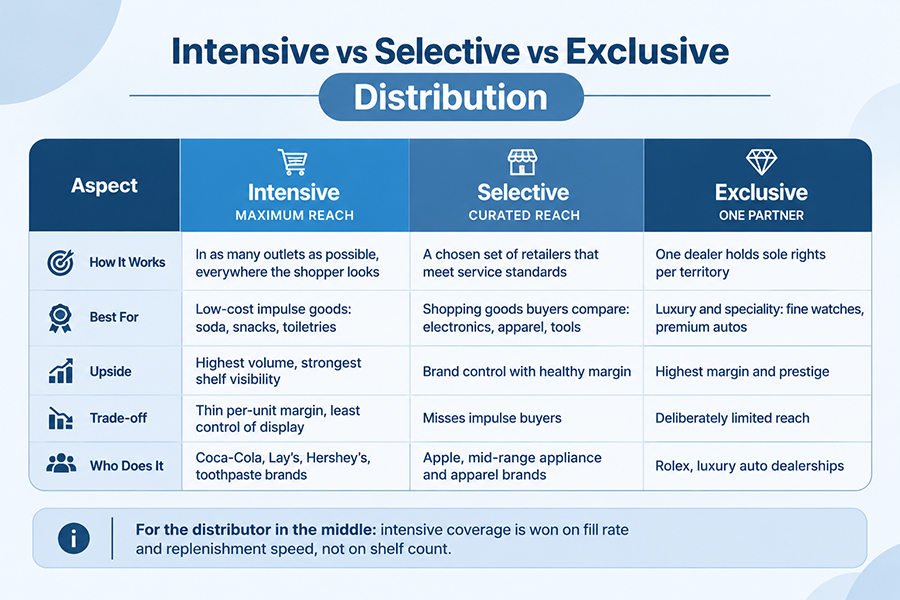
Intensive distribution is one of three levels of market coverage. They differ on a single variable: how many outlets are allowed to sell the product.
| Intensive | Selective | Exclusive | |
|---|---|---|---|
| How it works | Every outlet that will stock it | A chosen set of retailers that meet standards | One dealer with sole rights per territory |
| Best for | Low-cost impulse goods | Shopping goods buyers compare | Luxury and specialty items |
| Upside | Highest volume and visibility | Brand control with healthy margin | Highest margin and prestige |
| Trade-off | Thin margins, least display control | Misses impulse buyers | Deliberately limited reach |
| Who runs it | Coca-Cola, Lay’s, toothpaste brands | Apple, mid-range appliances and apparel | Rolex, luxury auto dealerships |
Most manufacturers do not pick one and stop. A household-goods company might run its flagship line intensively while keeping a premium sub-brand selective, and the distributor serving both has to support two different replenishment rhythms from one warehouse.
Is Extensive Distribution the Same Thing?
Mostly, yes. Extensive distribution and mass distribution are both used as synonyms for intensive distribution, and the three terms appear interchangeably in marketing textbooks. Where writers do separate them, extensive usually describes the geographic spread of a channel, how many markets it reaches, while intensive describes the density of outlets inside each of those markets. In practice the distinction rarely changes a decision, and the terms are safe to treat as one.
The Advantages of Intensive Distribution for Wholesalers & Distributors
For businesses like yours, an intensive distribution strategy offers several key benefits:
- Increased Market Reach: You can tap into a massive customer base, reaching people you might otherwise miss.
- Higher Profitability: By capturing both planned and impulse purchases, you increase sales volume and overall revenue.
- Brand Building and Trust: Constant visibility builds customer familiarity and trust, making your products a reliable, go-to choice.
The Challenges (and How to Overcome Them)
While intensive distribution can be highly profitable, it comes with its own set of challenges:
- High Costs: It requires significant investment in inventory, logistics, and supply chain management to serve numerous retail locations.
- Increased Competition: A saturated market means you’re fighting for shelf space and customer attention against many competitors.
- Complexity: Managing relationships with a large number of retailers and overseeing a vast distribution network can be incredibly complex.
What Intensive Distribution Demands From a Distributor
Every article on this subject is written from the brand’s side of the table. For the wholesale distributor who has to actually supply those shelves, intensive distribution is not a marketing decision at all. It is a fill-rate problem, and it is where the strategy is won or lost.
- Fill rate beats shelf count: A brand in 4,000 stores that is out of stock in 400 of them is really in 3,600. Service level, not placement count, is what the retailer measures and what the brand renews on.
- Replenishment is measured in hours: Bread, milk and beverages turn too fast for weekly cycles. Minimum and maximum levels have to be set per branch and per season, not per item.
- Every channel wants a different pack: The same product ships as an each to a convenience store, an inner pack to a drugstore and a pallet to a big-box chain, and each has its own price.
- Orders arrive in every format at once: EDI from the chains, a portal order from a buying group, a phone call from the independent down the road, all needing to land in one order book.
- Returns and credits scale with reach. More outlets means more damaged goods, more short-dated stock and more deduction claims, each of which quietly removes margin after the sale is booked.
The operational answer to all five is the same, and it is unglamorous: one system where inventory, pricing, orders and fulfilment share a database. Connecting eCommerce and EDI ordering to the ERP and warehouse management system gives real-time visibility of stock, pricing and order status across every channel, which is what makes a high fill rate repeatable instead of heroic.
How Ximple Solutions Can Help You Win at Intensive Distribution
XimpleERP is built for wholesale distributors rather than adapted for them, which matters for exactly the five pressures above:
- Fill rate: Inventory is tracked by branch with available-to-promise visibility, so a counter in one location can see stock in another.
- Replenishment: Min and max levels run per branch, with seasonal profiles for fast-turning lines.
- Channel pricing: Matrix and contract pricing handles a different price per channel and pack size without a spreadsheet.
- One order book: EDI, the B2B portal and phone orders all write into the same order book.
- Margin protection: Rebate and deduction tracking keeps the margin you booked after the sale.
Book a demo and we will walk through replenishment and fill rate with your own numbers.
Conclusion
Intensive distribution is the right strategy when a product is cheap, bought often, and easy to substitute, and the wrong one for anything a customer will travel or wait for. The marketing decision is straightforward. The hard part belongs to the distributor in the middle, who has to turn maximum availability into a fill rate that holds up on a Monday morning in four hundred stores at once. That is a systems problem before it is a sales problem.
FAQ
Intensive distribution is a strategy that places a product in as many retail outlets and sales channels as possible to maximize availability. It is used for low-cost, high-turnover goods such as beverages, snacks, confectionery and toiletries, where a shopper will usually buy a substitute rather than look elsewhere for a specific brand. The trade-off is thin per-unit margins, heavy logistics and limited control over how each store prices or displays the product.
Coca-Cola is the clearest example. The same product is stocked in supermarkets, convenience stores, gas stations, restaurants, vending machines and stadium kiosks at the same time, so it is within reach almost anywhere a person becomes thirsty. Potato chips, chocolate bars, chewing gum, bottled water, toothpaste and batteries all follow the same pattern.
Convenience goods that are inexpensive, bought frequently and easily substituted. Typical categories are beverages, salty snacks, confectionery, bread and milk, toiletries such as soap and toothpaste, over-the-counter medicines, batteries, newspapers and cleaning supplies. The common test is whether a shopper would accept a different brand rather than visit another store.
Intensive distribution puts the product in every outlet that will carry it, which maximizes volume and visibility but thins margins and gives up control of how it is displayed. Selective distribution limits sales to a chosen set of retailers that meet service or presentation standards, which reaches fewer impulse buyers but protects margin and brand control. Intensive suits convenience goods; selective suits shopping goods that buyers compare before purchase.
They are generally the same thing. Extensive distribution and mass distribution are both used as synonyms for intensive distribution in marketing literature. Where a distinction is drawn, extensive refers to how many geographic markets a channel reaches while intensive refers to the density of outlets within each market, but the two terms are usually interchangeable.
Intensive, selective and exclusive. Intensive distribution uses as many outlets as possible and suits low-cost impulse goods. Selective distribution uses a limited set of chosen retailers and suits mid-range products that buyers compare. Exclusive distribution grants sole selling rights to one dealer per territory and suits luxury or specialty goods where prestige and service matter more than reach.
Ready to Master Intensive Distribution?