
WMS – Warehouse Management system
Sections: Ultimate Inventory Control, Supply Chain Automation, Seamless Order Processing, Easy Compliance Management, All-in-One Business Integration, FAQs
By Ximple Team
•
•
3–4 min read
•
Warehouse Management System (WMS)
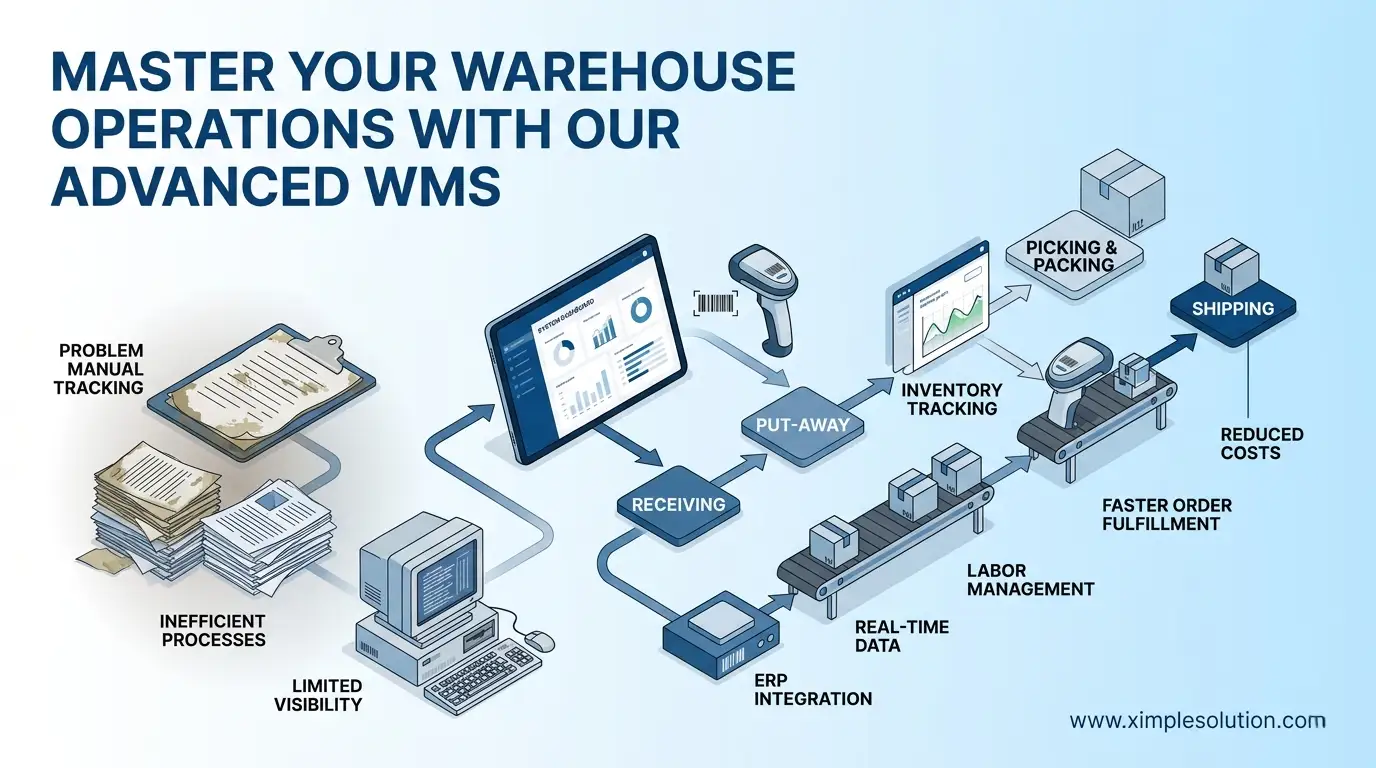
There are different types of software for business management. One of the most popular software solutions for suppliers is the warehouse management system, or WMS. It is a tool that helps businesses manage and control everything that happens in a warehouse. From inventory management to order shipment, the warehouse management system is an important business tool. During WMS implementation, companies can buy it as a standalone system or use it as a module within ERP (Enterprise Resource Planning) software.
The original WMS solutions were simple automated tools with essential functions like order picking, packing, and shipment management. However, modern WMS platforms are more advanced and can handle complex interactions with other business systems and devices. As a result, human errors are reduced significantly. In addition, vendors can locate ordered items quickly inside their warehouses. Therefore, businesses should adopt WMS warehouse management system software to reduce paperwork and improve automation.
WMS ERP Difference
Now you know the answer to this question: What is a warehouse management system? The next thing to understand is the difference between WMS and ERP systems. Although both systems support distribution businesses, they serve different purposes. Some enterprise resource planning systems include a warehouse management system module. However, this module is not always as advanced as dedicated warehouse management software.
When comparing WMS vs. ERP, the main similarity is that both are useful for wholesale and distribution businesses. The primary difference is their main function. A WMS system shows the movement and storage of inventory in real time. Through this system, distributors can monitor stock behavior and avoid operational issues. It also tracks products from warehouse shelves to shipping locations.
On the other hand, ERP software provides a complete view of all business departments. It includes modules for accounting and finance, sales and order processing, inventory management, customer relationship management, human capital management, project management, purchasing, warehouse management, and more.
Depending on the ERP software a business uses, purchasing a separate WMS may not be necessary. For example, if the ERP system already includes inventory and warehouse management modules, the software can still track items during receiving, picking, packing, and dispatching processes. It can also manage bin and shelf locations effectively.
However, businesses should invest in a complete WMS solution if they require advanced warehouse management capabilities. A dedicated WMS is more suitable for large-scale distribution operations with complex workflows. At the same time, a complete WMS solution is generally more expensive than using a WMS module within an ERP system.
Essential Features of WMS
Warehouse management systems offer many useful functions. These functions become possible because of different WMS features, including the following:
Warehouse Design
The software can assign bin slots based on inventory items and optimize inventory allocation. Additionally, it can manage seasonal inventory fluctuations effectively.
Inventory Tracking
The software uses AIDC (Automatic Identification and Data Capture) tools such as barcode scanners to track inventory movement accurately.
Picking and Packing Tasks
This is one of the most important WMS components. It supports batch picking, zone picking, and wave picking methods.
Receiving and Putaway
Using pick-to-voice and pick-to-light technologies, this feature helps workers receive and store products efficiently.
Shipping
This feature helps businesses send bill of lading documents before shipment arrival. In addition, the software can generate packing lists and invoices. It can also send advance shipment notifications to customers and recipients.
Yard and Dock Management
This function helps truck drivers locate suitable loading docks before arriving at the warehouse. Furthermore, it can support cross-docking operations when logistics processes become more complex.
Labor Management
This feature includes KPIs and performance metrics that help managers identify top-performing workers and employees who need improvement.
Reporting
Reporting features allow managers to analyze warehouse operations and identify weak areas that require improvement.
Benefits of WMS
No matter how businesses deploy a WMS warehouse system, it provides several advantages, including:
- Saves time
- Accurate inventory control and management
- Better customer service
- Improved warehouse space utilization
- Higher worker productivity
- Lower labor costs because the software reduces human errors
Types of WMS – Cloud WMS and On-Premise WMS
Without a doubt, WMS software provides many valuable benefits. However, businesses must choose the right deployment model to achieve maximum results. The two major types of warehouse management systems include the following:
Standalone or On-Premise WMS
An on-premise WMS operates on office hardware and internal business networks. Therefore, businesses usually integrate standalone WMS software with existing business management tools. In many cases, companies connect it with ERP software.
Cloud WMS
A cloud-based WMS is a modern and flexible solution that uses advanced cloud technology. Through the Software as a Service (SaaS) model, cloud WMS platforms provide scalability, security, and flexibility. Moreover, businesses receive automatic software updates, and employees can access the system from any location.
Open-source WMS
Open-source software is generally free to use. Businesses can access and use the software without paying licensing fees. Small businesses with simple supply chain operations often choose open-source WMS solutions because they are more affordable and easier to manage. In addition, these systems usually include only the basic warehouse management features required for smaller operations.
WMS Software Selection Criteria for Distributors
When selecting the best warehouse storage management system, distributors should consider several important factors:
- How well the software matches business requirements
- The type of licensing agreement available
- Whether the software requires monthly subscription payments
- Cost of implementation and employee training
- Software customization capabilities
- Software update costs
- Backup and redundancy support during technical issues
- Total cost of ownership
- Compatibility with internal business processes and company philosophy
Implementation of the WMS System
Implementing an enterprise warehouse management system can be a long and challenging process. Therefore, businesses should prepare properly and involve all relevant stakeholders. Company directors, logistics managers, operations managers, and warehouse managers should share their expectations before implementation begins.
Risk management is another important consideration during implementation. The implementation team must identify operational risks and take preventive measures to reduce potential issues. In many cases, teams review the complete warehouse workflow to identify weaknesses and operational gaps.
Businesses should also create a clear implementation schedule while considering possible risks and unexpected challenges. In addition, strong teamwork between the software implementation team and the software provider is essential for project success.
Training is equally important during WMS implementation. Employees should understand how to use the system properly and how to customize features if future operational needs change.
Data migration from an old system to a new system is another critical step. Incorrect or missing data can create costly business problems later. Finally, testing and deployment phases require careful planning and technical expertise to ensure smooth operations.
WMS Integration with ERP
In some cases, ERP WMS systems offer better value than dedicated WMS solutions. Businesses planning to adopt ERP software should ensure the ERP includes warehouse management functionality. Alternatively, businesses with existing ERP software can integrate it with a suitable WMS solution.
However, WMS and ERP integration can be complex. Therefore, businesses often require professional expertise for successful implementation. Similar to WMS implementation, ERP integration requires proper planning to avoid duplicate data, process errors, and additional operational costs.
Best WMS Systems for Distributors
Businesses have many options when selecting the best WMS system for distribution operations. Popular solutions include NetSuite, Odoo, Manhattan Associates, Softeon, Fishbowl Inventory, HighJump, SkuVault, and Mobe3 WMS.
Businesses searching for ERP software designed specifically for wholesale distribution can consider Ximple Solution. It is a next-generation ERP software platform developed for distribution businesses. In addition, it provides a scalable and cost-effective cloud WMS solution that helps distributors improve customer service, reduce inventory costs, and increase employee productivity.
Conclusion
A modern WMS tool helps businesses manage picking, packing, shipping, and inventory movement efficiently. It improves warehouse productivity and helps employees perform tasks more accurately.
When choosing between a dedicated WMS solution and an ERP WMS module, businesses should evaluate their operational complexity and long-term requirements carefully. Complex warehouse operations may require a dedicated warehouse management system. However, many businesses can manage operations successfully using a WMS module inside ERP software.
After understanding the importance of WMS software, businesses can select the most suitable solution based on their operational needs. Ximple WMS provides a strong foundation for wholesale distribution businesses through scalable cloud-based ERP and warehouse management capabilities.
FAQ
ERP software provides real-time visibility of all SKUs, including vape flavors, nicotine strengths, and hardware. It tracks stock levels, batch numbers, and expiry dates automatically, helping wholesalers avoid stockouts, reduce overstocking, and maintain better control over fast-moving inventory.
Yes. ERP systems can be configured to support compliance needs such as age verification tracking, product documentation management, and regulatory reporting. This reduces the risk of penalties and ensures businesses stay aligned with industry regulations.
Unlike manual systems, ERP automates order processing, invoicing, inventory updates, and shipping workflows. This reduces human errors, speeds up operations, and integrates all business functions into one system, leading to smoother and more efficient distribution management.
Manage inventory, picking, packing, shipping, and warehouse operations from one centralized ERP platform.
Ximple WMS helps distribution businesses improve productivity, reduce manual work, and scale operations efficiently.