
What is a Distribution Strategy? Importance of Distribution Strategy
Sections: What is Distribution Strategy?, Choosing the Right Strategy, Digital Distribution Strategy, Distribution Strategy Examples, Types of Distribution Strategy, Selecting the Right Strategy, Distribution Software Modules, Direct vs. Indirect Distribution, Conclusion
By Ximple Team
•
•
3–4 min read
•
Distribution Strategy
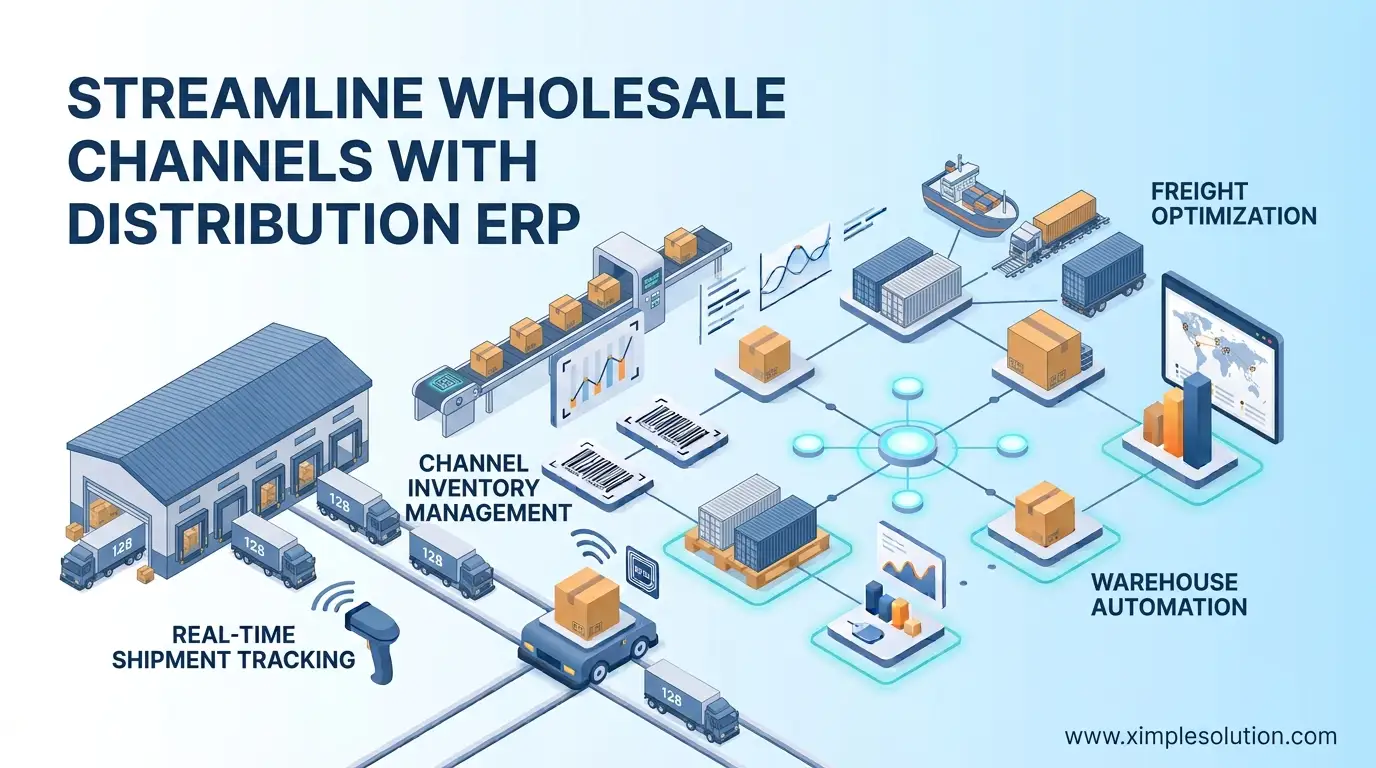
Did you know that sales are the key to higher revenues and contented workers? That’s true, and if you want to sell more, you should make a plan. First, you should have a goal to attract and retain customers. Second, you should deliver a product or service to the customer and the correct information. To achieve this, you should come up with a distribution strategy that goes well with your business needs. This strategy will help you manage the complete sales process. But, do you know what it is all about? If not, don’t worry; this guide will educate you.
What is a Distribution Strategy?
In a nutshell, the best distribution strategy definition is a plan to help you deliver a product or a service to the customers you are targeting via a supply chain. This plan includes all the approaches you would use to give the customers what they expect from you. A good strategy can incorporate your distribution channels or employ other companies’ channels. In addition, your business can use its exclusive stores or sell through other retail stores.
Moreover, a business can use both its stores and third-party retail chains. In modern times, especially after the Covid-19 epidemic, companies are using online exclusive sales channels. Hence, you should pick a distribution channel strategy that suits your business. The best approach will help you deliver goods or services to the target audience at optimal distribution costs. It will also maximize your sales revenues and profits. On the other hand, Bad distribution strategy types will cause losses and let your competitors win.
How to select the right Distribution Strategy
Now you know what a distribution strategy is. Next, you will learn how to select the right one for your business. There are a few factors to reflect on, and they include:
Check the market status right now
Before coming up with a distribution marketing strategy, carry out a thorough market analysis. The goal is to discover the correct way to distribute the type of products you sell. For instance, if you deal with consumer goods, the proper technique is FMCG distribution. Only a meticulous market analysis can reveal the appropriate distribution channels for your products. It can also help you study customers’ buying behavior and pinpoint their specific needs.
Distribution costs
No matter the channel you choose, there will be costs to incur. If you select a more comprehensive direct distribution strategy, it means you will sell directly to the final customer. The method is more straightforward, but it has some costs to incur. The more comprehensive strategy involving intermediaries is more convenient, and goods can reach customers almost immediately. However, every intermediary should earn something to continue being loyal to you. In essence, you should develop charts and graphs showing potential costs and profits from each distribution channel.
Do you sell complex or simple products?
As you try to create a sales distribution strategy, focus on your product. The product is complex in that it requires technical support after delivery. Do the customers need an after-sale service, such as installation and maintenance help? If so, you should sell it more directly to go to a dealer and then to a customer. The dealer will help your customers sort out their issues. On the other hand, if your product is a typical household appliance, such as a blender, you can select an extended distribution channel for it.
What profits are you targeting?
If you choose the shortest distribution method, your business revenues can increase. Nonetheless, this can happen only if you don’t sell FMCG products. For these, you need a more extended distribution channel to increase your revenues and profits. In some situations, higher revenues may not translate to higher net profits.
What will be your market share?
How quickly can your business establish itself in a new market? If such a market is already saturated, you will find it hard to penetrate a new market. There will be competitors doing well already, and it will take longer to get a market share. So you have to do you distribute strategy math very carefully.
Where your product is in its life cycle
If your product is new, a more extended distribution channel is necessary to ensure it is recognized on the market. As you choose who to connect and grow with, you should consider their availability and expertise.
Distribution Strategy: Stay competitive in the Digital World
As you think of how to make a distribution strategy, focus on technology. First, think of how to use technology to promote and sell your products. In this case, you should explore eCommerce as a distribution channel. It is estimated that by 2021, e-commerce sales will reach 4.8 trillion. Why wouldn’t you want to be part of that? Countless people are using apps to buy things online, and you can sell to them too. Secondly, you can use technology to implement your preferred distribution strategy. As you will learn below, there is software that can help you manage your supply chain processes
Distribution Strategy examples.
A suitable distribution strategy example will vary depending on the marketing channels you have selected. First, a direct channel occurs when a manufacturer sells straight to the consumer. The channel must be short if it’s direct. Hence, good examples of this are primarily retail brands that sell fast foods and perishable goods.
An indirect marketing channel, it occurs when the path is long and complex. Typically, there will be many distributors and middlemen. Examples can be soft drinks companies, including Coca-Cola and Pepsi An intensive distribution strategy is more intensive and considers more than just the size of a distribution channel. It uses a more aggressive approach, and examples include vehicle brands and distributors of household appliances.
Moreover, a business can use an exclusive strategy when it has a high brand value to protect. It will open stores in major cities with upper-income and classy customers and still outdo its competitors. Examples are big fashion houses with high-end designer products.
Lastly, some businesses use a selective distribution strategy. You will find them on almost every street, or they may start a few stores in every major town. Good examples are big supermarkets and retail chains.
What are the different types of Distribution Strategy?
Direct Distribution
Here, manufacturers sell directly to the end consumer. Some direct distributors sell online, particularly those targeting younger generations that have more technological knowledge. The rest use product catalogs, product lists, phone calls, and other advertising methods.
Indirect Distribution
It is the opposite of the direct distribution method. Simply, this method entails intermediaries like wholesalers, retailers, and agents.
Intensive Distribution
As aforementioned, this technique entails a more aggressive and extensive marketing approach. Hence, several retail outlets are opened to reach more customers and increase sales revenues and profits.
Exclusive Distribution Strategy
This method is a preference of companies that sell luxury goods. To purchase their products, you must approach their dealership. A good example here can be the Mercedes Benz car brand.
Selective Distribution
This technique is partly similar to intensive and exclusive strategies. Those who use this technique know full well that not all people will be interested in their products. So they set up stores in some selected areas. Their stores don’t sell anything else, and if they pick external stores, these will sell closely related products.
How can I select the right distribution strategy for my wholesale business?
If you are a wholesaler, you need a product distribution strategy that works for your business. There are different types of systems, but some may not work for your business. The system that might work for you might not help the next wholesaler. You can opt for direct marketing via telemarketing and product catalogs or choose eCommerce marketing. It can be trial and error at first, but eventually, you will discover the best strategy for your business. Briefly, you should:
Know your customers perfectly
Ensure you find out who your target customers are, what they need from you, how soon they want it delivered, and where
Focus on your product
If you sell perishable goods or daily-use products, by all means, choose a direct channel. On the other hand, if you deal with non-perishable goods, choose indirect marketing channels. More to the point, select your intermediaries wisely.
Seek Professional Help
As a wholesaler in any industry, you have competitors. Any small error in decision-making can cost your business considerable losses in terms of time and money. Thus, if you honestly can’t select the right distribution strategy alone, find a professional who can help you.
After finding a distribution strategy to get the message to customers, the next thing is to implement it. As technology has become more innovative than ever, you should use it in your business. More specifically, you should start searching for the best distribution software. It would be best if you bought wholesaler distribution software as it is designed for your business. Not only will it make the distribution process easier to track, but it can also reduce human errors and stress.
A good software tool for distributors should have automation capabilities. In other words, it should boost productivity and ensure that you complete tasks quickly. Another component of this software is RFID tracking which simplifies inventory monitoring in real-time. It is based on a modern technology called the Internet of Things. Moreover, the software needs to have all business management modules in a central position. The most common modules are accounting, warehousing management, customer relationships management, inventory management, and procurement management. Lastly, the software should be cloud-based rather than in-house. Cloud-based distribution software is easy to access from any place, anytime, as long as there is a Wi-Fi hotspot and mobile gadget.
Key Modules of the Distribution Software
Distribution software includes modules to plan, administer, execute, track, and report the tasks performed in distribution warehouses operated by wholesale distributors. It manages the flow of materials throughout the distribution process. Key features of distribution software include
- Sales Order Management
- CRM
- Inventory Management
- E-Commerce
- Product Catalog
- Employee Management
- Billing
What is the difference between Direct and Indirect Distribution?
In direct distribution, the product is distributed to the end-user from the manufacturer’s or distributor’s warehouse. This is usually the case for a manufacturer that sells its items via a distribution center or retail outlet. In indirect distribution, the product (i.e. a service) is provided through a supplier or agent who’s contractually obligated through the manufacturer to buy the products and supply them to the end-user. The indirect distribution technique is regularly used by manufacturers and distributors to make certain they don’t oversell or have leftover products.
Direct Distribution = Direct-to-consumer (DTC) is a distribution channel that is not utilized by the brand. The main reason for the use of this channel is to gain a competitive benefit as it is a quicker and more direct way to reach the customer. Companies use direct distribution channels for customer products as it is very effective. This is a direct method of reaching the consumer with the product.
Indirect distribution is an indirect form of distribution channel and is used to sell products and services. It is also called indirect marketing. It is a form of marketing that involves a company or individual taking someone else to make a sale for them. This is known as indirect distribution as it does not involve the company or individual going to the customer directly.
Conclusion
Choosing the right distribution strategy can make or break how efficiently your product reaches customers — and how much it costs you to get there. Whether you go direct to avoid intermediaries, indirect to leverage established retail networks, intensive to maximize shelf presence, or selective/exclusive to protect a premium brand image, the best choice always comes down to your product type, target customer, and delivery expectations. Many wholesalers use a mix of these strategies rather than relying on just one, adapting as their business and customer base grow. Whatever combination you choose, having the right systems in place — from inventory visibility to order automation — makes it far easier to execute your distribution strategy consistently and profitably. That’s where a platform like Ximple Solutions comes in, helping distributors manage the complexity behind whichever strategy they choose.
FAQ
There are four core distribution strategies: direct, indirect, intensive, and selective (which includes exclusive distribution). Direct distribution means selling straight to the end customer without intermediaries, often through an eCommerce site, catalog, or phone sales. Indirect distribution relies on middlemen — such as wholesalers or retailers — to move goods from manufacturer to customer. Intensive and selective/exclusive strategies determine how many outlets carry the product, ranging from mass availability to a single branded point of sale.
The right strategy depends on your product type, customer expectations, and delivery timelines. Perishable or daily-use goods generally do better with a direct channel, while non-perishable products often benefit from indirect channels through trusted intermediaries. It helps to first identify your target customers, understand what they need and how quickly they expect delivery, and choose intermediaries carefully since your distribution partners directly affect your competitiveness in the market.
Intensive distribution pushes a product into as many retail outlets as possible — ideal for high-turnover, low-cost items like snacks that customers buy on impulse. Exclusive distribution is the opposite: the product is sold through only one designated outlet or branded store per location, a model commonly used for luxury goods like high-end vehicles. Selective distribution sits between the two, combining traits of both by placing products in a curated set of branded and department stores.
Not Sure Which Distribution Strategy Fits Your Business?
Whether you’re going direct, indirect, intensive, or exclusive, executing it well takes more than a plan — it takes the right systems behind it. Ximple Solutions’ ERP software gives wholesalers real-time inventory visibility, automated order processing, and multi-channel supply chain control, so your distribution strategy actually runs the way you designed it.