
What Is EDI Invoicing? The EDI 810 Explained for Distributors
Sections: What Is EDI Invoicing?, What Is an EDI 810 Invoice?, How EDI Invoicing Works, EDI Documents Used, EDI Invoice Example, EDI vs. PDF vs. E-Invoicing, Why Distributors Automate Invoicing, EDI in Distribution ERP, FAQs, Conclusion
By Ximple Team
•
•
3–4 min read
•
EDI Invoicing
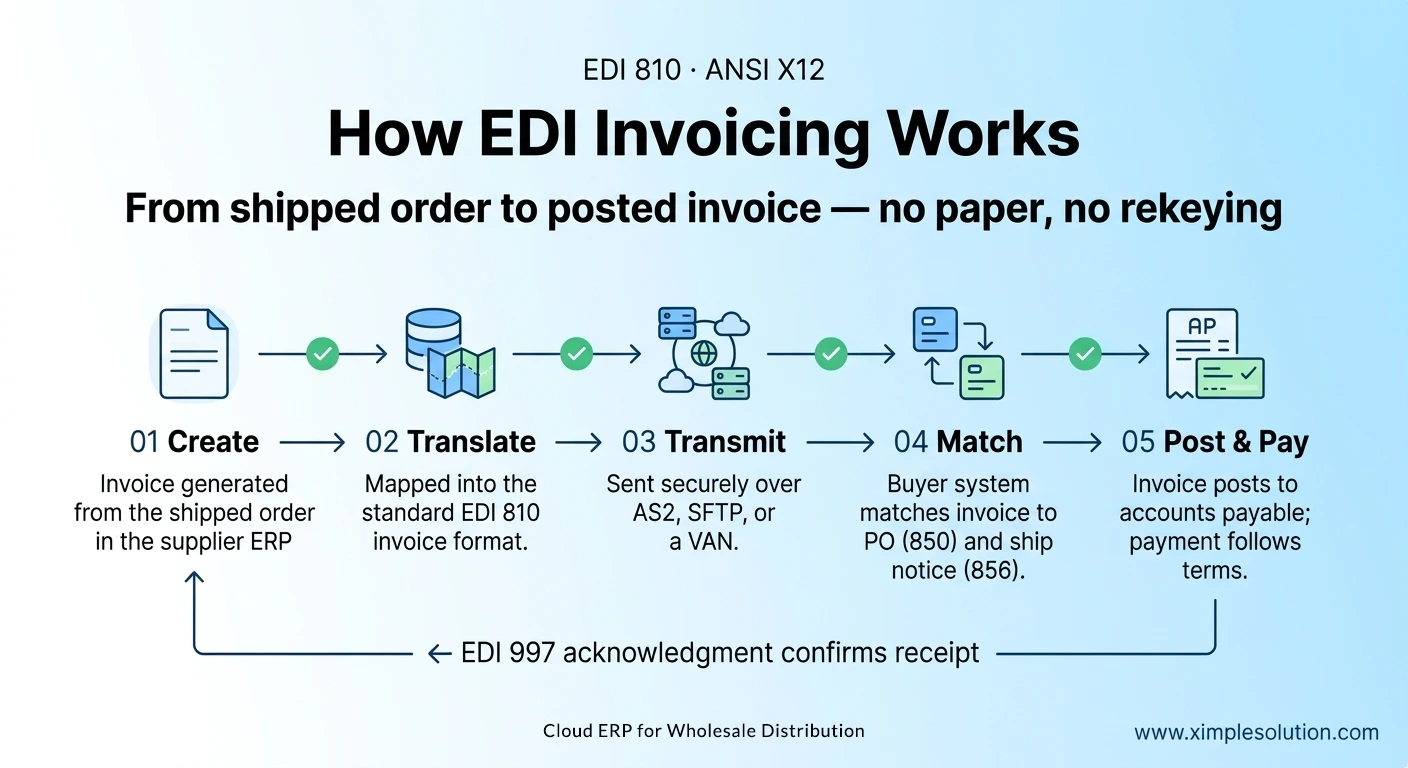
EDI invoicing is how most large retailers, buying groups, and big-box customers now insist on being billed – and sooner or later they send every supplier the same letter: start invoicing us by EDI, or chargebacks begin. If you just received one – or you are tired of rekeying invoices that customers still pay late – this guide explains what EDI invoicing is, how the EDI 810 document works, what a real one looks like, and how distributors automate the whole flow inside their ERP.
What Is EDI Invoicing?
EDI invoicing is the computer-to-computer exchange of invoice data between a supplier and a buyer in a standardized electronic format, with no paper, no PDF, and no manual data entry. The invoice travels as an EDI 810 document – a structured file defined by the ANSI X12 standard in North America and EDIFACT internationally – that the buying companys accounting or ERP system can read, validate, and post automatically.
The point is not only speed. Because the data is machine readable, nothing gets retyped, so the line errors, price mismatches, and lost invoices that cause payment disputes largely disappear. The invoice arrives seconds after the order ships, and it arrives in a form the buyer can act on immediately.
What Is an EDI 810 Invoice?
The EDI 810 is the electronic version of the paper invoice. It states who is billing whom, which purchase order it bills, the line items with quantities and prices, payment terms, and the total due. The supplier sends it after shipping, and it references the documents that came before it: the purchase order (EDI 850) the buyer sent, and the advance ship notice (EDI 856) the supplier sent when the goods left the dock.
One common mix-up: the EDI 210 is not a product invoice. The 210 is a freight invoice from a motor carrier for transportation charges. If a trading partner asks you to send invoices by EDI, they mean the 810.
How EDI Invoicing Works: 5 Steps
Step 1 – Creation
The supplier generates the invoice in its own ERP or billing system, usually straight from the sales order that was just shipped. Nothing is retyped: the order lines become the invoice lines.
Step 2 – Translation
Software maps the invoice into the standardized EDI 810 format. In older setups a separate EDI translator does this; in an ERP with integrated EDI, the system produces the 810 directly.
Step 3 – Transmission
The file travels to the buyer over a secure channel – AS2, SFTP, or a value added network (VAN). No email, no attachment, no portal upload.
Step 4 – Validation and matching
The buying system checks the file, then matches the invoice against the purchase order (EDI 850) and the ship notice (EDI 856). Order, shipment, and invoice agree – the classic three way match – before anything posts.
Step 5 – Acknowledgment and posting
The buyer system sends back an EDI 997 functional acknowledgment confirming receipt, the invoice posts to accounts payable, and payment follows the agreed terms. Some partners also send an EDI 820 remittance advice describing the payment.
The EDI Documents That Travel With an Invoice
The 810 never travels alone. A typical distribution trading relationship runs on a small set of documents:
| Document | Name | Who sends it | What it does |
|---|---|---|---|
| EDI 850 | Purchase order | Buyer to supplier | Places the order that everything else references |
| EDI 855 | PO acknowledgment | Supplier to buyer | Confirms what will ship, at what price, and when |
| EDI 856 | Advance ship notice (ASN) | Supplier to buyer | Describes the shipment before it arrives, carton by carton |
| EDI 810 | Invoice | Supplier to buyer | Requests payment for the shipped order |
| EDI 997 | Functional acknowledgment | Both directions | Requests payment for the shipped order |
| EDI 820 | Payment / remittance advice | Buyer to supplier | Requests payment for the shipped order |
| EDI 210 | Motor carrier freight invoice | Carrier to payer | A freight bill, not a product invoice – often confused with the 810 |
What Does an EDI Invoice Look Like? (Example)
In raw form, an 810 is a plain text file of coded segments. Here is a simplified example – one invoice, one line item:
ST*810*0001
BIG*20261104*INV-88412***PO-55071
N1*ST*ACME ELECTRIC SUPPLY
IT1*1*48*EA*8.95**BP*CBL-12AWG-500
TDS*42960
CTT*1
SE*7*0001
- ST: – start of an 810 invoice document
- BIG: – the invoice date, invoice number INV-88412, and the purchase order PO-55071 it bills
- N1*ST: – the ship to party, here Acme Electric Supply
- IT1: – one line item: 48 units at 8.95 each, buyer part number CBL-12AWG-500
- TDS: – the total amount due, expressed in cents
- CTT: – a count of the line items, used to verify nothing was lost
- SE: – end of the document
Nobody reads this by hand. The receiving system translates it in seconds, which is exactly the point: a document format built for software, not for people.
EDI Invoice vs. PDF Invoice vs. E-Invoicing
- EDI invoice (810): Structured, machine to machine data between two trading partners. No human reads it, types it, or extracts it. Built for high volume, repeat trade – which is what distribution is.
- PDF invoice over email: A picture of an invoice. Someone, or an OCR tool, has to read it and key it into the buying system – and every keystroke is a chance for an error, a dispute, and a late payment.
- E-invoicing: A broader family of XML formats exchanged over networks or government platforms, used widely for tax compliance in Europe and Latin America. In North American retail and distribution, EDI remains the standard.
Why Distributors Automate Invoicing
- Faster payment: The invoice arrives seconds after shipment instead of days, which shortens days sales outstanding.
- Fewer errors and chargebacks: Big box retailers deduct for invoice discrepancies. Structured data removes the typos that cause them.
- Lower processing cost: Industry analyses consistently put the cost reduction of electronic invoice processing at 60 to 80 percent compared with paper handling.
- Compliance with trading partners: Many retailers and buying groups make EDI a condition of doing business. Meeting the mandate keeps the account.
- Cleaner reconciliation: Invoice, order, and shipment tie together in the three way match, so disputes get settled from data instead of phone calls.
EDI Invoicing in a Distribution ERP
For a wholesale distributor, EDI invoicing is not an accounting project – it is a sales requirement. The customers who mandate it are usually the largest accounts on the book, and every manual workaround between the order and the invoice costs margin on exactly those accounts.
That is why the cleanest setup is EDI integrated in the ERP itself. The 810 is generated from the same sales order that drove the pick, pack, and ship – no separate translation service to babysit, no rekeying between systems. The invoice goes out the moment the order ships, and accounts receivable updates in the same system.
Ximple ERP includes integrated EDI for wholesale distributors, so customer orders come in electronically and ship notices and invoices go back out from one system. If your customers are mandating EDI invoicing, book a live demo and we will walk the whole flow – from inbound order to outbound 810 – running live.
Conclusion
EDI invoicing replaces the slowest document in the order-to-cash cycle with a structured 810 that moves from the supplier ERP to the buyer system in seconds. The mechanics are simple – create, translate, transmit, match, post – and the payoff is concrete: faster payment, fewer errors and chargebacks, and large customers kept happy.
For a distributor, the deciding question is not whether to adopt EDI invoicing – your biggest customers already decided that for you. It is whether the 810 comes out of the same system that runs your orders, warehouse, and receivables, or out of one more bolt-on to maintain. If you want to see the integrated version working, book a live demo.
FAQ
An EDI 810 is the electronic invoice document in the ANSI X12 standard. A supplier sends it to a buyer after shipping an order to request payment. It carries the same information as a paper invoice – invoice number, purchase order reference, line items, quantities, prices, and terms – in a structured format that the buying system can post automatically.
EDI invoicing is a point-to-point exchange of structured documents between two trading partners, and it is the standard in North American retail and distribution. E-invoicing usually refers to broader XML formats exchanged over networks or government platforms, common for tax compliance in Europe and Latin America. Both replace paper; they use different standards and networks.
Yes. EDI remains the backbone of invoicing in retail, grocery, automotive, and wholesale distribution. Large retailers and buying groups continue to mandate EDI from their suppliers, and modern cloud ERP systems have made it cheaper to run rather than replacing it.
Traditional EDI needs setup work for each trading partner – document mapping, testing, and sometimes network fees. A standalone translation service adds one more layer to maintain. Most of that burden disappears when EDI is integrated in the ERP itself, because documents are generated and consumed by the same system that already runs orders and invoices.
Both are invoices, but for different things. The 810 is the product invoice a supplier sends a buyer for goods. The 210 is a freight invoice a motor carrier sends to collect transportation charges. When a trading partner asks for your invoice document, they almost always mean the 810.
In raw form it is a plain text file of coded segments – ST, BIG, IT1, TDS – each carrying one piece of the invoice. Nobody reads it by hand: the receiving system translates and posts it in seconds. The example in this guide shows a simplified 810 and what each line means.
Ready to see it in action?
See how Ximple ERP helps wholesale distributors streamline orders, inventory, purchasing, and invoicing—all in one system. Book a live demo today and discover how to simplify your distribution operations.